I cloned an entire SaaS in 30 minutes. Here’s what that actually means.
Being able to build something doesn’t mean you want to.

Travis Street · 4 min read
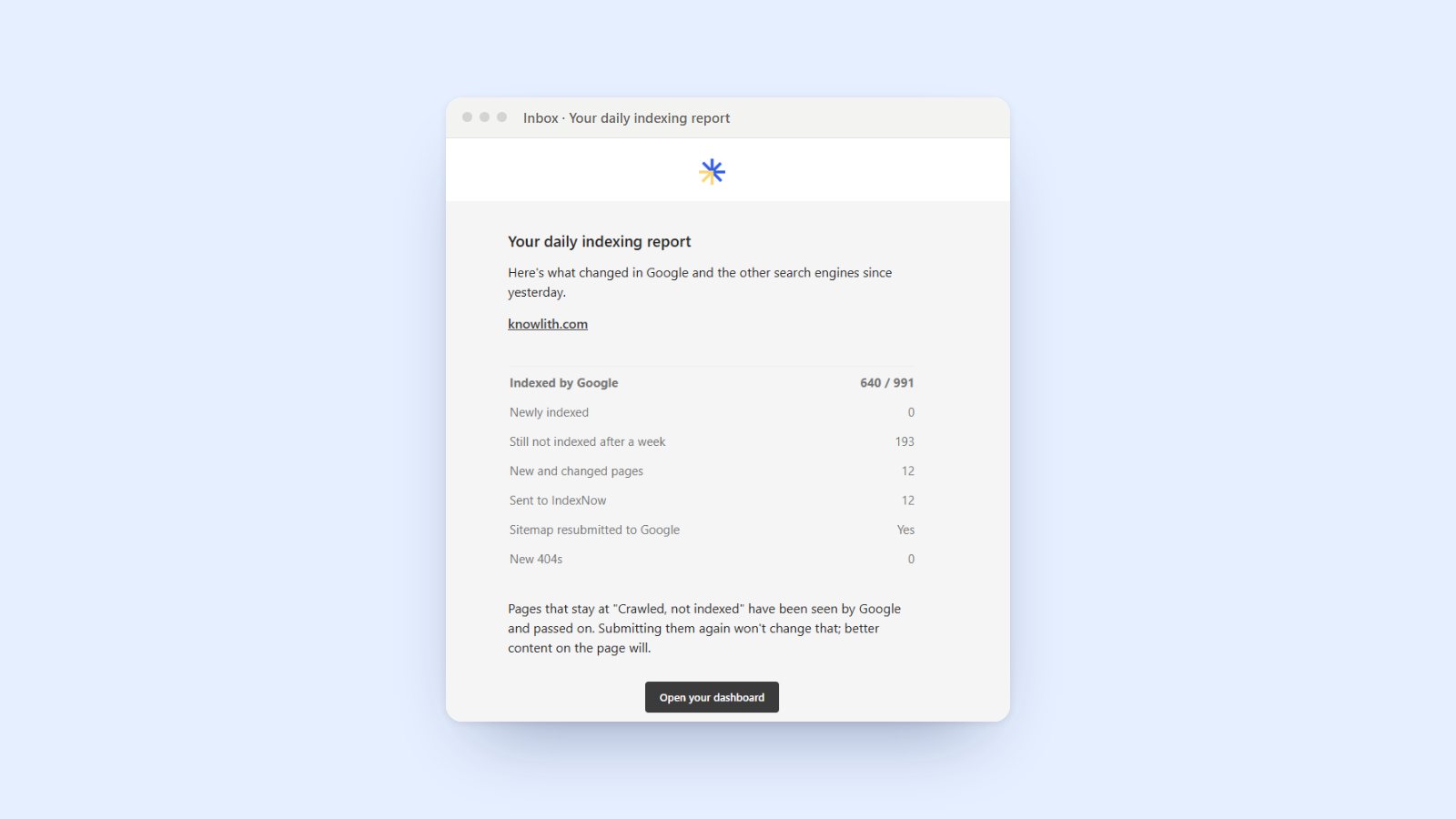
The daily indexing report my version sends me every morning.
In October I posted on LinkedIn that I’d cloned an entire SaaS in 30 minutes. It went further than anything I’d posted there before. Plenty of people read it as “software is dead”. That’s not what I meant, so here’s the longer version.
What happened
I was using a small SEO indexing tool. It does one job: it helps get new pages discovered and indexed faster. It’s a single-feature product and it does that feature well.
I’d bought a lifetime deal for $45. Then I wanted to use it on more of my sites, and adding nine more sites was going to cost me another $450. Ten times what I’d paid for the tool itself, for the same tool.
So I built my own. It took about half an hour with Claude Code, on the stack I use for everything: Laravel, self-hosted on my own VPS.
I rebuilt the functionality, nothing else. My version verifies that I own a site with a TXT file, then connects to Google Search Console and handles indexing every day. I didn’t copy their code, their design or anything else of theirs. I reproduced a function, not a business.
I use it every day. Each morning it emails me an indexing report for each site: how many pages Google has indexed, what’s new or changed, what’s been sent to IndexNow and any new 404s. It’s become one of the most useful emails I get.
What the 30 minutes actually covered
Thirty minutes got me a working tool for my own use, which I’m still relying on. It did not get me a product.
A product would need accounts, billing, onboarding, error handling for other people’s weird setups, documentation, support, a website that explains it, and someone answering emails when it breaks at 2am. My version has none of that, because it only needs to work for one customer: me.
That gap is the whole point of this article. The visible functionality of a lot of software is now cheap to reproduce. Everything around it is not.
Being able to build something doesn’t mean you want to
The line from the original post that people quoted back to me most was this one: being able to build something doesn’t mean you want to.
Most people, even people who could rebuild the tool, will still pay for it. I’ll probably keep paying for plenty of software I could clone in an afternoon. Maintaining your own version of a tool is a job. You have to fix it when an API changes, keep it secure and remember how it works six months later. For most businesses, $45 or even $450 is cheaper than that.
Convenience is a much bigger advantage than people give it credit for. So are trust, reliability and someone you can email when things go wrong.
So what does change?
Two things, I think.
First, pricing gets harder to defend when the product is a single feature. If your pricing punishes your best customers for using the product more, and the thing you do can be rebuilt in an afternoon, some of those customers will rebuild it. Not most. But the technical ones, the ones with lots of sites, the ones who were going to be your biggest accounts. Charging me ten times more for nine more sites was the moment I stopped being a customer.
Second, if you’re building software, the code isn’t your moat. It probably never was, but it’s now obvious. What protects you is everything else: your distribution, your relationships with customers, the data you’ve built up, your support, your brand and how much easier you make someone’s life compared with doing it themselves.
What this means if you’re a founder
If you’re starting something new, assume your features can be copied quickly. Don’t spend months perfecting functionality in private. Spend that time on the things that are hard to copy: understanding a specific customer better than anyone else, getting in front of them repeatedly and making the product genuinely easy to live with.
If you already run a SaaS, look at your pricing through the eyes of a technical customer with an AI coding tool. Is there a point where your pricing makes rebuilding it look sensible? If there is, that’s where you’ll lose people, quietly.
And if you’re thinking “great, I’ll just clone the tools I pay for”: you can, for some of them. Do it for the tools where the maths is genuinely silly. For everything else, you’re trading a subscription for a maintenance job.
Software has got cheaper to build. Businesses haven’t got cheaper to run. That’s the gap I write about, and it’s why I think the interesting work now is on the business side, not the build.
Want shorter ideas between issues? Follow me on LinkedIn, Bluesky and X.